
International Training

Starting in FY2027, the National Institute for Defense Health Cooperation (NIDHC) will launch a Health Security Cooperation Education & Training (HSCET) program, absorbing the mission of the Defense Institute for Medical Operations (DIMO), which closes on October 1, 2026. All DIMO courses continue under NIDHC in FY2027. Contact NIDHC-education@usuhs.edu for course requests.
About our HSCET program
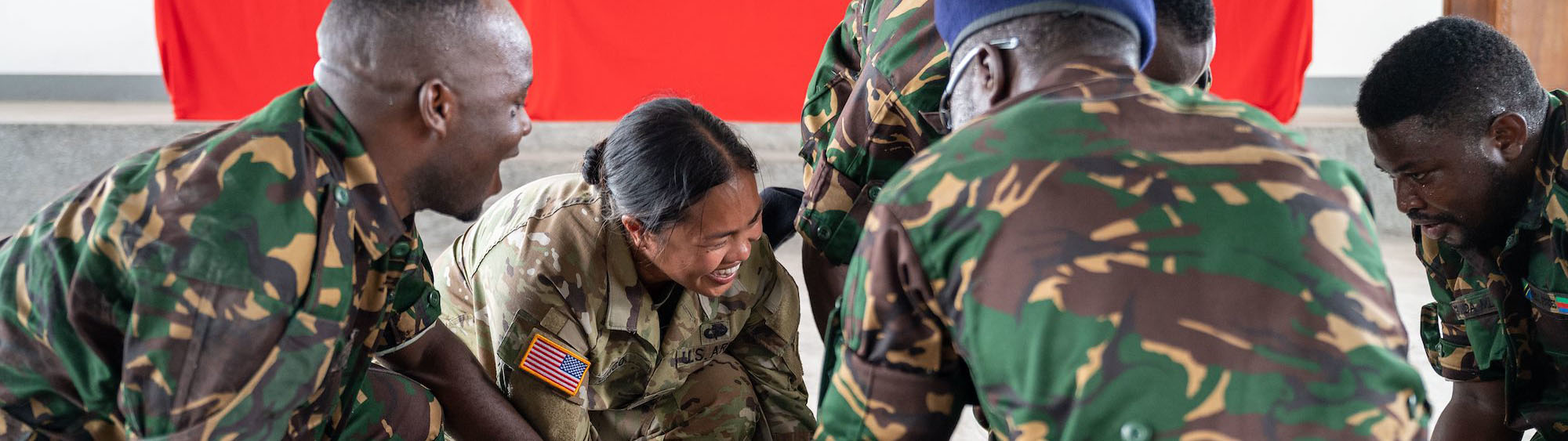
NIDHC, at the Uniformed Services University of the Health Sciences, is an International Military Education & Training (IMET) certified schoolhouse providing Health Security Cooperation training. Using Title 22 and Title 10 security assistance authorities, NIDHC delivers specialized training through in-residence and mobile courses. By leveraging Department of War (DoW) and federal interagency experts, NIDHC develops curricula to build partner capacity and strengthen relationships.
Course offerings
Building Partner Capacity
- Tactical Combat Casualty Care (TCCC) Tier 3: Combat Medic/Corpsman (CMC): 10 days, 6-24 students- MASL D319083
- Covers the 3 phases of combat casualty care (Care Under Fire, Tactical Field Care & Casualty Evacuation) per CoTCCC/NAEMT guidelines, including advanced skills. Instructor certification/NAEMT training site available. Audience: Medical providers (Doctors, Nurses, PAs, Paramedics, Medics) in austere combat.
- Tactical Combat Casualty Care (TCCC) Tier 2: Combat Lifesaver (CLS): 5 days, 6-24 students- MASL D319058
- Covers the basics of the 3 phases of combat casualty care per CoTCCC/NAEMT guidelines. Audience: Non-medical (operational/support) personnel.
- Prehospital Trauma Life Support (PHTLS): 5 days, 6-24 students- MASL D319127
- Provides international NAEMT certification in prehospital trauma patient management, focusing on high-quality, evidence-based, immediate lifesaving care. Offered as instructor/training site certification or as an addition to a TCCC site build. Audience: Medics, Paramedics, Nurses, PAs, Doctors, and other prehospital providers.
- Aeromedical Evacuation Team (AMET): Multi-phase MTTs, 5-10 days, class size 25- MASL D319110
- Multi-phase program for developing an Aerial Patient Movement Program (potentially UN Certified). Audience: Doctors, Nurses, Medics, and Air Crew.
- Phase 1 (10 days): Aeromedical patient care, equipment, aircraft interaction. Identify future instructors.
- Phase 2 (10 days): Develop AMET student instructors to teach Phase 1.
- Phase 3 (8 days): En-route critical care management (Alpha and Bravo patients).
- Phase 4 (5 days): Culmination Exercise demonstrating mastery and program ownership.
- Multi-phase program for developing an Aerial Patient Movement Program (potentially UN Certified). Audience: Doctors, Nurses, Medics, and Air Crew.
- Mass Casualty Incident (MCI) Response: 10 days, class size 25- MASL D319315
- MCI principles: command, control, communication, situational awareness, patient assessment, triage, treatment, tracking, and evacuation (ground/air). Modalities: classroom, hands-on, and exercise. Audience: Medical Personnel (emergency responders, Doctors, Nurses, Medics, Leaders).
- Mental Health Services - Combat Related/PTSD: 5 days, class size 50- MASL D319304
- PTSD recognition, prevention, disaster response, and clinical management. Focuses on methods for resiliency and reintegration. Audience: Medical and mental health personnel.
- International Military Education & Training (E-IMET) Fundamentals of Healthcare Administration: 5 days, class size 50- MASL D319308
- Examines healthcare operations and administration. Improves financing, delivery, and organization of personnel. Audience: Personnel involved with healthcare administration.
- (E-IMET) Nursing Leadership: 5 days, 45 students (MASL D319311)
- Develops nursing leaders by advancing knowledge, promoting positive work environments, and strengthening the nursing force with a global focus on daily challenges. Uses didactic learning, group work, and a capstone. Audience: Mid- to senior-level nursing leaders, credentialed providers, administrators, and political decision-makers from MoH/MoD.
- Point of Care Ultrasound: 5 days, 6-24 students (MASL D319051)
- Students learn POC ultrasound image acquisition and interpretation. Modularized to meet country needs; delivered as Train-the-Trainer to build local instructors. Audience: Medical Providers caring for acutely ill or injured patients.
Humanitarian Assistance & Disaster Relief
- (E-IMET) Disaster Planning - Basic: 5 days, 50 students (MASL D319310)
- Covers building a national disaster plan and integrating local/regional response into the nation’s emergency management system. Audience: Planners, emergency management, police, fire, rescue, and medical personnel (combined military/civilian groups preferred).
- (E-IMET) Disaster Planning - Advanced: 5 days, 50 students (MASL D319316)
- Exercises disaster response planning and emergency management concepts to improve interagency coordination. Audience: Planners, emergency management, police, fire, rescue, and medical personnel (combined military/civilian groups preferred).
- (E-IMET) Disaster Planning & Emergency Management - Senior Leaders: 2 Days, class size 20- MASL D319320
- Prepares senior officials for national disaster management, focusing on national emergency management strategies, policy, and case studies. Audience: Senior officials in planning and emergency management.
- (E-IMET) Public Health Emergencies: Humanitarian Assistance & Disaster Response: 5 days, class size 40- MASL D319321
- Trains health sector personnel for disaster response using core systems and interventions via a progressive multi-day tabletop exercise. Audience: Emergency response personnel (public health and medical planners).
Needs Assessment
- Training Needs Assessment/Site Survey: 2-5 days- MASL D319302
- Reviews and assesses current capabilities; formulates future medical training needs for sustainable programs. Jointly develops a cooperation plan outlining objectives and matching training events (includes monitoring, evaluation, and DOTMLPF assessment). Audience: Embassy personnel, Partner Nation personnel (includes facilities tour).
Force Health Protection
- Outbreak Detection & Response: 5 days, class size 50- MASL D319326
- Covers surveillance, recognition, case management, and response. Supports International Health Regulations and Global Health Security Agenda. Promotes biosafety/biosecurity systems and addresses ethical considerations in outbreak response for vulnerable populations. Audience: Public health, healthcare workers, and lab personnel.
- Infection Control in High Consequence Infectious Disease: 5 days, size 50- MASL D319318
- Apply infection control to reduce hospital infectious disease threats during outbreaks/pandemics. Includes safe handling of remains, medical waste disposal, and PPE simulation. Audience: Healthcare workers, Medical Planners.
- Operational Preventive Medicine: 5 days, size 50- MASL D319314
- Pre/post-deployment readiness and health screenings for deployed forces. Covers medical prophylaxis, risk assessment, prevention, management & monitoring. Audience: Medical personnel involved with deployment, public health, healthcare providers/commanders.
Chemical/Biological/Radiological/Nuclear Threats
- CBRN Incident & Medical Response: 5 days, size 40- MASL D319322
- Incident management & initial hospital response to CBRN. Exercises include PPE, DECON, facility protection, and initial victim management. Audience: Healthcare personnel and administrators.
Resident Courses (San Antonio, TX)
- (E-IMET) Executive Healthcare Resource Management: 10 days, size 20, ECL: 80- MASL D175466
- Focuses on Healthcare Systems, population health, quality/performance improvement, and managed care tools. Covers resource management and critical decision-making to improve access and quality of care. Audience: Mid-grade to Senior officers and civilian equivalents in Executive Healthcare Management roles within military or government hospitals/health.
- (E-IMET) Disaster Planning & National Emergency Management Capability: 10 days, class size 42, ECL: 70- MASL D175206
- Understand/apply the phases of Emergency Management and the value of working with internal and external partners Demonstrate understanding of an integrated emergency response plan through exercises and facilitated discussions. Audience: Officers and civilian equivalents who are experienced and novice emergency managers; and up-and -coming experts needing additional subject matter training.
To request courses, or for more information, please contact NIDHC at NIDHC-education@usuhs.edu.