
International Training

Starting in FY2027, the National Institute for Defense Health Cooperation (NIDHC) will launch a Health Security Cooperation Education & Training (HSCET) program, absorbing the mission of the Defense Institute for Medical Operations (DIMO), which closes on October 1, 2026. All DIMO courses continue under NIDHC in FY2027. Contact NIDHC-education@usuhs.edu for course requests.
About our HSCET program
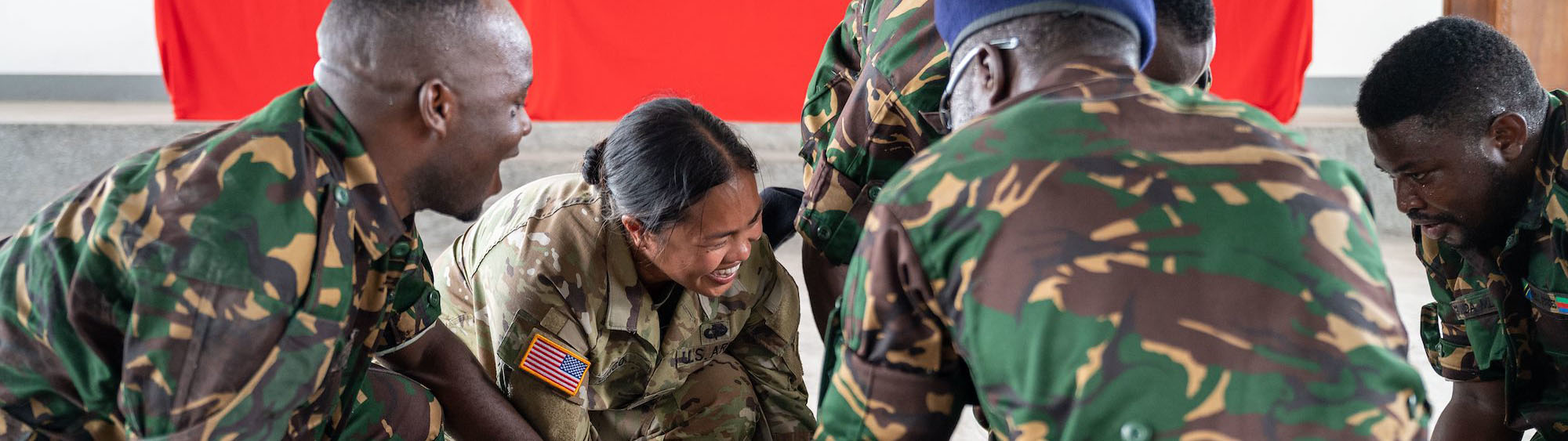
NIDHC, at the Uniformed Services University of the Health Sciences, is an International Military Education & Training (IMET) certified schoolhouse providing Health Security Cooperation training. Using Title 22 and Title 10 security assistance authorities, NIDHC delivers specialized training through in-residence and mobile courses. By leveraging Department of War (DoW) and federal interagency experts, NIDHC develops curricula to build partner capacity and strengthen relationships.
Interested in becoming an HSCET Instructor? We invite you to learn more and submit an instructor application: NIDHC Health Security Cooperation Education and Training (HSCET) Instructor Application
To request courses, or for more information, please contact NIDHC at NIDHC-education@usuhs.edu.
Course offerings
Building Partner Capacity
- Tactical Combat Casualty Care (TCCC) Tier 3: Combat Medic/Corpsman (CMC): 10 days, 6-24 students- MASL D319083
- Covers the 3 phases of combat casualty care (Care Under Fire, Tactical Field Care & Casualty Evacuation) per CoTCCC/NAEMT guidelines, including advanced skills. Instructor certification/NAEMT training site available.
Audience: Medical providers (Doctors, Nurses, PAs, Paramedics, Medics) in austere combat.
- Covers the 3 phases of combat casualty care (Care Under Fire, Tactical Field Care & Casualty Evacuation) per CoTCCC/NAEMT guidelines, including advanced skills. Instructor certification/NAEMT training site available.
- Tactical Combat Casualty Care (TCCC) Tier 2: Combat Lifesaver (CLS): 5 days, 6-24 students- MASL D319058
- Covers the basics of the 3 phases of combat casualty care per CoTCCC/NAEMT guidelines.
Audience: Non-medical (operational/support) personnel.
- Covers the basics of the 3 phases of combat casualty care per CoTCCC/NAEMT guidelines.
- Prehospital Trauma Life Support (PHTLS): 5 days, 6-24 students- MASL D319127
- Provides international NAEMT certification in prehospital trauma patient management, focusing on high-quality, evidence-based, immediate lifesaving care. Offered as instructor/training site certification or as an addition to a TCCC site build. Audience: Medics, Paramedics, Nurses, PAs, Doctors, and other prehospital providers.
- Aeromedical Evacuation Team (AMET): Multi-phase MTTs, 5-10 days, class size 25- MASL D319110
- Multi-phase program for developing an Aerial Patient Movement Program (potentially UN Certified). Audience: Doctors, Nurses, Medics, and Air Crew.
- Phase 1 (10 days): Aeromedical patient care, equipment, aircraft interaction. Identify future instructors.
- Phase 2 (10 days): Develop AMET student instructors to teach Phase 1.
- Phase 3 (8 days): En-route critical care management (Alpha and Bravo patients).
- Phase 4 (5 days): Culmination Exercise demonstrating mastery and program ownership.
- Multi-phase program for developing an Aerial Patient Movement Program (potentially UN Certified). Audience: Doctors, Nurses, Medics, and Air Crew.
- Mass Casualty Incident (MCI) Response: 10 days, class size 25- MASL D319315
- MCI principles: command, control, communication, situational awareness, patient assessment, triage, treatment, tracking, and evacuation (ground/air). Modalities: classroom, hands-on, and exercise.
Audience: Medical Personnel (emergency responders, Doctors, Nurses, Medics, Leaders).
- MCI principles: command, control, communication, situational awareness, patient assessment, triage, treatment, tracking, and evacuation (ground/air). Modalities: classroom, hands-on, and exercise.
- Mental Health Services - Combat Related/PTSD: 5 days, class size 50- MASL D319304
- PTSD recognition, prevention, disaster response, and clinical management. Focuses on methods for resiliency and reintegration.
Audience: Medical and mental health personnel.
- PTSD recognition, prevention, disaster response, and clinical management. Focuses on methods for resiliency and reintegration.
- International Military Education & Training (E-IMET) Fundamentals of Healthcare Administration: 5 days, class size 50- MASL D319308
- Examines healthcare operations and administration. Improves financing, delivery, and organization of personnel.
Audience: Personnel involved with healthcare administration.
- Examines healthcare operations and administration. Improves financing, delivery, and organization of personnel.
- (E-IMET) Nursing Leadership: 5 days, 45 students (MASL D319311)
- Develops nursing leaders by advancing knowledge, promoting positive work environments, and strengthening the nursing force with a global focus on daily challenges. Uses didactic learning, group work, and a capstone.
Audience: Mid- to senior-level nursing leaders, credentialed providers, administrators, and political decision-makers from MoH/MoD.
- Develops nursing leaders by advancing knowledge, promoting positive work environments, and strengthening the nursing force with a global focus on daily challenges. Uses didactic learning, group work, and a capstone.
- Point of Care Ultrasound: 5 days, 6-24 students (MASL D319051)
- Students learn POC ultrasound image acquisition and interpretation. Modularized to meet country needs; delivered as Train-the-Trainer to build local instructors. Audience: Medical Providers caring for acutely ill or injured patients.
Humanitarian Assistance & Disaster Relief
- (E-IMET) Disaster Planning - Basic: 5 days, 50 students (MASL D319310)
- Covers building a national disaster plan and integrating local/regional response into the nation’s emergency management system.
Audience: Planners, emergency management, police, fire, rescue, and medical personnel (combined military/civilian groups preferred).
- Covers building a national disaster plan and integrating local/regional response into the nation’s emergency management system.
- (E-IMET) Disaster Planning - Advanced: 5 days, 50 students (MASL D319316)
- Exercises disaster response planning and emergency management concepts to improve interagency coordination.
Audience: Planners, emergency management, police, fire, rescue, and medical personnel (combined military/civilian groups preferred).
- Exercises disaster response planning and emergency management concepts to improve interagency coordination.
- (E-IMET) Disaster Planning & Emergency Management - Senior Leaders: 2 Days, class size 20- MASL D319320
- Prepares senior officials for national disaster management, focusing on national emergency management strategies, policy, and case studies.
Audience: Senior officials in planning and emergency management.
- Prepares senior officials for national disaster management, focusing on national emergency management strategies, policy, and case studies.
- (E-IMET) Public Health Emergencies: Humanitarian Assistance & Disaster Response: 5 days, class size 40- MASL D319321
- Trains health sector personnel for disaster response using core systems and interventions via a progressive multi-day tabletop exercise.
Audience: Emergency response personnel (public health and medical planners).
- Trains health sector personnel for disaster response using core systems and interventions via a progressive multi-day tabletop exercise.
Needs Assessment
- Training Needs Assessment/Site Survey: 2-5 days- MASL D319302
- Reviews and assesses current capabilities; formulates future medical training needs for sustainable programs. Jointly develops a cooperation plan outlining objectives and matching training events (includes monitoring, evaluation, and DOTMLPF assessment).
Audience: Embassy personnel, Partner Nation personnel (includes facilities tour).
- Reviews and assesses current capabilities; formulates future medical training needs for sustainable programs. Jointly develops a cooperation plan outlining objectives and matching training events (includes monitoring, evaluation, and DOTMLPF assessment).
Force Health Protection
- Outbreak Detection & Response: 5 days, class size 50- MASL D319326
- Covers surveillance, recognition, case management, and response. Supports International Health Regulations and Global Health Security Agenda. Promotes biosafety/biosecurity systems and addresses ethical considerations in outbreak response for vulnerable populations.
Audience: Public health, healthcare workers, and lab personnel.
- Covers surveillance, recognition, case management, and response. Supports International Health Regulations and Global Health Security Agenda. Promotes biosafety/biosecurity systems and addresses ethical considerations in outbreak response for vulnerable populations.
- Infection Control in High Consequence Infectious Disease: 5 days, size 50- MASL D319318
- Apply infection control to reduce hospital infectious disease threats during outbreaks/pandemics. Includes safe handling of remains, medical waste disposal, and PPE simulation.
Audience: Healthcare workers, Medical Planners.
- Apply infection control to reduce hospital infectious disease threats during outbreaks/pandemics. Includes safe handling of remains, medical waste disposal, and PPE simulation.
- Operational Preventive Medicine: 5 days, size 50- MASL D319314
- Pre/post-deployment readiness and health screenings for deployed forces. Covers medical prophylaxis, risk assessment, prevention, management & monitoring. Audience: Medical personnel involved with deployment, public health, healthcare providers/commanders.
Chemical/Biological/Radiological/Nuclear Threats
- CBRN Incident & Medical Response: 5 days, size 40- MASL D319322
- Incident management & initial hospital response to CBRN. Exercises include PPE, DECON, facility protection, and initial victim management.
Audience: Healthcare personnel and administrators.
- Incident management & initial hospital response to CBRN. Exercises include PPE, DECON, facility protection, and initial victim management.
Resident Courses (Washington, D.c.)
- (Pending E-IMET) Executive Healthcare Resource Management: 10 days, size 20, ECL: 80- MASL D175210
- Focuses on Healthcare Systems, population health, quality/performance improvement, and managed care tools. Covers resource management and critical decision-making to improve access and quality of care.
Audience: Mid-grade to Senior officers and civilian equivalents in Executive Healthcare Management roles within military or government hospitals/health.
- Focuses on Healthcare Systems, population health, quality/performance improvement, and managed care tools. Covers resource management and critical decision-making to improve access and quality of care.
- (E-IMET) Disaster Planning & National Emergency Management Capability: 10 days, class size 42, ECL: 70- MASL D175206
- Understand/apply the phases of Emergency Management and the value of working with internal and external partners
- Demonstrate understanding of an integrated emergency response plan through exercises and facilitated discussions.
Audience: Officers and civilian equivalents who are experienced and novice emergency managers; and up-and -coming experts needing additional subject matter training.
- (Pending E-IMET) Health Emergencies in Large Populations (HELP): 10 days, class size 42, ECL: 70- MASL D175207 (Maryland), D175208 (Hawaii)
- Understand/apply the phases of Emergency Management and the value of working with internal and external partners.
- Demonstrate understanding of an integrated emergency response plan through exercises and facilitated discussions.
Audience: Officers and civilian equivalents who are experienced and novice emergency managers; and up-and -coming experts needing additional subject matter training.