
ADVANCING THE FRONTIER OF DISASTER MEDICINE, MILITARY MEDICINE, & OPERATIONAL HEALTH

The National Institute for Defense Health Cooperation (NIDHC) serves as a training hub for civil-military (civ-mil) disaster medicine, military medicine, and operational health. In addition to core offerings like Health Emergencies in Large Populations (HELP) and Domestic Disaster Preparedness, NIDHC collaborates across USU schools to deliver specialized training to students. The Institute supports signature operational exercises, including Operation Bushmaster and Operation Gunpowder. These immersive programs ensure future military medical leaders are expertly prepared to lead and provide care in high-intensity, austere environments.
Highlights
NIDHC maintains strategic academic and professional partnerships to advance the field of disaster medicine and operational health. In collaboration with UMass and the American College of Emergency Physicians (ACEP), we deliver the Disaster Medicine Lecture Series, complemented by our comprehensive Disaster Health Core Curriculum. To further develop the next generation of medical leaders, NIDHC offers the Operational Impact Scholars Program in partnership with Texas A&M and the USU Enlisted to Medical Degree Preparatory Program (EMDP2). These initiatives provide active-duty military personnel seeking medical school admission with critical hands-on research experience.
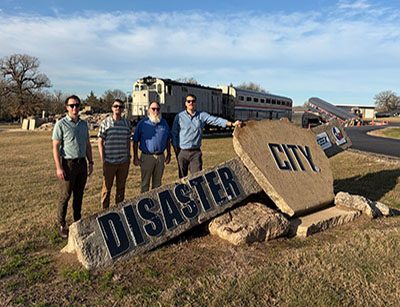

Collaborate With Us: nidhc-education@usuhs.edu.
Integrated across our Health Security Cooperation Education and Training and Global Health Engagement initiatives, our disaster medicine portfolio is fundamental to how we support the Joint Force and global partners. From our academic home at the Uniformed Services University, we continue to shape the future of the field—equipping both students and seasoned professionals with the interoperable skills required for a resilient, synchronized, and effective health response.
Quick Links
The Humanitarian Leader (HELP): Intensive technical training for civilian and military health practitioners in large-scale emergencies.
PMO 1009 Domestic Disaster Management And Response- Academic Excellence (USU): Graduate-level disaster medicine instruction integrated into Global Health and Master’s degree programs. Delivering disaster medicine content to Global Health and Master’s students in partnership with the Uniformed Services University.
Disaster Health Core Curriculum
In disaster medicine and public health, competencies are essential for measuring a responder’s ability to execute complex, high-stakes tasks. NIDHC pioneered this field by collaboratively identifying 11 core competencies (and 36 sub-competencies), published as the "Core Competencies for Disaster Medicine and Public Health" (2012). This framework serves as the foundational curriculum for domestic and international organizations—including the Medical Reserve Corps—and has informed specialized standards in nursing, mental health, and pediatrics.
The COVID-19 pandemic significantly shifted the requirements for effective response. To integrate these critical lessons learned, NIDHC is currently executing a two-phased project to modernize the Disaster Health Core Curriculum. This initiative focuses on:
- Revising core competencies based on real-world pandemic response data.
- Explicitly defining competencies for disaster and public health preparedness, response, and management.
- Identifying new content and opportunities to improve training and education for the modern operational environment.
Guided by a panel of subject matter experts, this analysis enables NIDHC to develop and disseminate an enhanced framework of disaster core competencies. This standardized collection serves as a vital resource for agencies, organizations, and academic institutions to build and refine their own disaster medicine and public health training curricula. The Disaster Health Core Curriculum is a free, online course designed to introduce healthcare professionals to a comprehensive array of disaster medicine topics. Across eleven modules, the curriculum encapsulates current response competencies and translates the latest research into effective clinical practices. Credit: CME, CNE, and CHES Available.
To access the training, please click on the bolded competency number adjacent to each title below:
|
|
|
|
|
|
|
|
|
|
||
|
|
|
|
|
|
|
|
|
|
|
|
|
|
|
|
|
|
||
|
|
|
|
|
|
|
|
|
|
|
|
|
|
|
Number of Contact Hours to be awarded: 7 Max.
Content for this education activity was chosen from: Walsh L, Subbarao I, Gebbie K, et al. Core Competencies for Disaster Medicine and Public Health. Disaster Medicine and Public Health Preparedness. 2012;6(1):44-52. doi:10.1001/dmp.2012.4
Through a partnership with the American Public Health Association, learners completing the Disaster Health Core Curriculum can earn continuing medical, nursing, and health education credits at no cost for a maximum of 7.0 AMA PRA Category 1 credit (s)™. To obtain continuing education credits, learners must complete the online assessments with a passing score of 70% or above and receive credit hours. Access the post-assessments and create an online account.
Note: an American Public Health Association membership is not required to access the assessment page. Competencies 1-2 and 6-7 are combined to receive full credit. Learners have the option to print individual certificates after each assessment.
Medicine (CME) Accreditation Statement
This activity has been planned and implemented in accordance with the Essential Areas and Policies of the Accreditation Council for Continuing Medical Education through the joint sponsorship of the American Public Health Association (APHA) and the (insert your organization). The APHA is accredited by the ACCME to provide continuing medical education for physicians.
Designation Statement: The APHA designates this (Virtual Course) educational activity for a maximum of (7) AMA PRA Category 1 Credit (s)™.
Nursing (CNE) Accreditation Statement
This nursing continuing professional development activity was approved by the American Public Health Association’s Public Health Nursing Section Approver Unit, an accredited approver by the American Nurses Credentialing Center’s Commission on Accreditation.
Health Education (CHES) Statement
Sponsored by the American Public Health Association (APHA), a designated approver of continuing education contact hours (CECH) in health education by the National Commission for Health Education Credentialing, Inc. This program is designated for Certified Health Education Specialists (CHES®) to receive up to (7) total Category I contact education contact hours
Program Disclosures:
During the past 24 months, the following planning committee members and speakers [Larissa Unruh, MD, MPH., Julie Townsend, DNP, RN.,Norma Quintanilla, MS., Mighty Fine, MPH, CHES., Matthew Wynia, MD., MPH, FACEP., Edbert Hsu, MD, MPH, FACEP., Lainie Rutkow, JD, MPH, PhD., and Daniel J. Barnett, MD, MPH] have had no financial relationship with an ineligible company that might potentially be biased or impact the content of the educational activity/session.