
Past Evaluations
MUCH/MESH EVALUATION STUDY
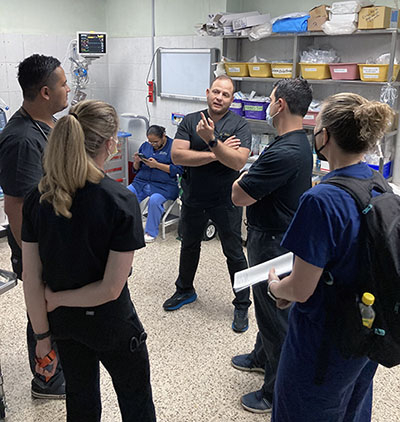
NIDHC conducted a tactical demonstration project to quantify the knowledge, skills, and abilities (KSAs) of military medicine physicians trained through the Military Unique Curriculum in Honduras (MUCH) and Military Emergency Skills in Honduras (MESH) Program. NIDHC evaluators developed and piloted an encounter checklist (E-KSA) with the aim of streamlining data collection efforts in alignment with military medical readiness standards while capturing contextual information relevant to medical operations in austere environments.
MUCH/MESH is an immersive training program enabling Residents and Attending Physicians to gain emergency medicine experience in resource-limited and austere settings. NIDHC, supported by USU Military and Emergency Medicine (MEM) faculty, accompanied MUCH/MESH participants to Hospital Escuela, using the encounter checklist (E-KSA) to document chief complaints, treatments rendered, and demonstrated KSAs. The NIDHC Research & Analysis Team refined the E-KSA tool during initial rotations to improve data capture and harmonize KSAs.
AFRICAN PARTNERSHIP OUTBREAK RESPONSE ALLIANCE (APORA) EVALUATION STUDY
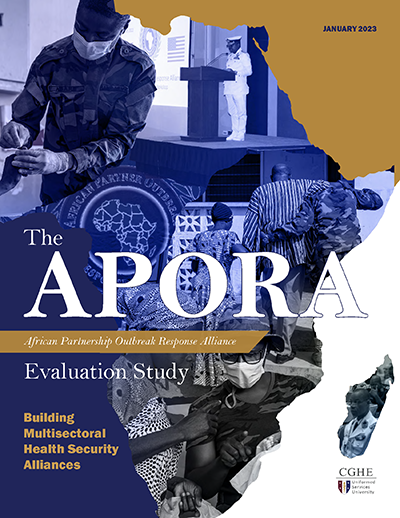
NIDHC initiated and completed the African Partnership Outbreak Response Alliance (APORA) evaluation study in support of USAFRICOM’s efforts to develop sustainable health security alliances amongst African partners. The outcome evaluation aimed to assist USAFRICOM’s efforts to advance the U.S. military’s role and understanding of military contributions in coordinated military-civilian impact pathways for global health security. The study featured a mixed-methods approach to explore APORA as a program that builds strategic alliances and the procedural, structural, and interpersonal elements and processes that exist for impactful military-civilian pathways.
The methods employed included document review, questionnaire implementation, and in-depth key informant interviews. NIDHC’s evaluation team attended the APORA-administered, CDC-led workshop for Rapid Response Team (RRT) training in Accra, Ghana. At this event, NIDHC evaluation personnel were able to collect interview and questionnaire data from APORA participants, partner nations leaders, and Ministry of Defense and Ministry of Health stakeholders. Interview data were collected from representatives from 14 countries, while questionnaire data were collected from personnel from 23 countries. The final report was completed in early 2023.
AFRICAN PEACEKEEPING RAPID RESPONSE PARTNERSHIP
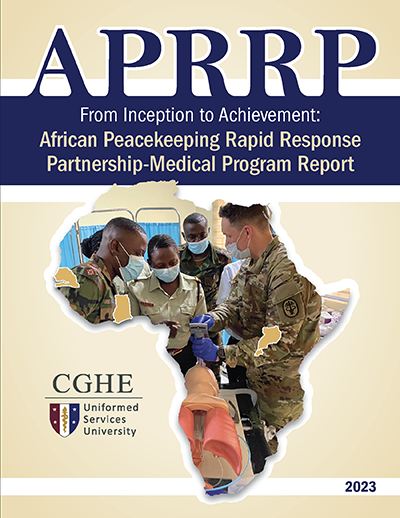
NIDHC managed and implemented the APRRP Medical program in support of the USAFRICOM Command Surgeon’s office. The program focused on assisting Ghana, Uganda, Rwanda, and Senegal to meet the following mission: “by December 2022, the partner nation (PN) has a deployable Level 2 Hospital (L2H) and is able to sustain this capability through organic training; hospital is registered at the Rapid Deployment Level (RDL) in the UN’s Peacekeeping Capability Readiness System (PCRS) and available to rapidly deploy to an emerging crisis.”
NIDHC supported and enabled each PN to institutionalize readiness training to operate the L2H in a field setting. The crawl, walk, run model implemented by NIDHC resulted in cadres of trainers and L2H training programs in each PN. Additionally, each PN demonstrated increased capacity to manage pre-deployment training programs to enable L2H operations and engaged in a process to actively plan for and manage the L2H package.
In 2023, APRRP transitioned to the Global Peace Operations Initiative. To enable the transition, NIDHC worked with PN senior medical leadership to develop a future investment and engagement plan focused on continuity and sustainability. Each transition plan considered key training priorities, identified gaps, and identified U.S. subject matter experts to advise and assist future efforts. While supporting the efforts of each PN, the experience gained over the six-year effort offers a reference point and model for future similar efforts.
In response to the COVID-19 pandemic, APRRP countries – with NIDHC support – deployed U.S.-procured Level 2 field hospitals in support of their domestic pandemic response, all while working with USAFRICOM to leverage this medical capability to its fullest potential.
After the full close-out of APRRP, NIDHC conducted an extensive review and analysis, and generated a summative medical program report on the entire program. This effort involved in-depth review and analysis of several hundred documents (post-engagement reports, technical assessment reports, program reports, and executive summaries), which spanned over 900 pages of documentation. The report was completed in early 2024.
IMPROVING PROCESS AND COORDINATION IN THEATER (IMPACT)
The Improving Processes and Coordination in Theater (IMPACT) award was used to illustrate the effectiveness of DoW GHE and translate this knowledge into usable tools and frameworks for the Joint Force. Three case evaluations concluded in 2020 and resulted in: a multi-level system evaluation framework to plan and assess capacity building initiatives; a leadership guide and planning checklist to increase the evaluability of DoW GHEs; and a novel demonstration using critical participatory narrative allowing adaptive emphasis on local participant perspectives of change. All three cases were presented at the 2020 American Evaluation Association annual conference as a multi-paper session supporting the Military and Veterans Topical Interest Group. These evaluations illustrated the relevance of assessment, monitoring, and evaluation in creating more effective security cooperation engagements.